
 Simon Kamuzinzi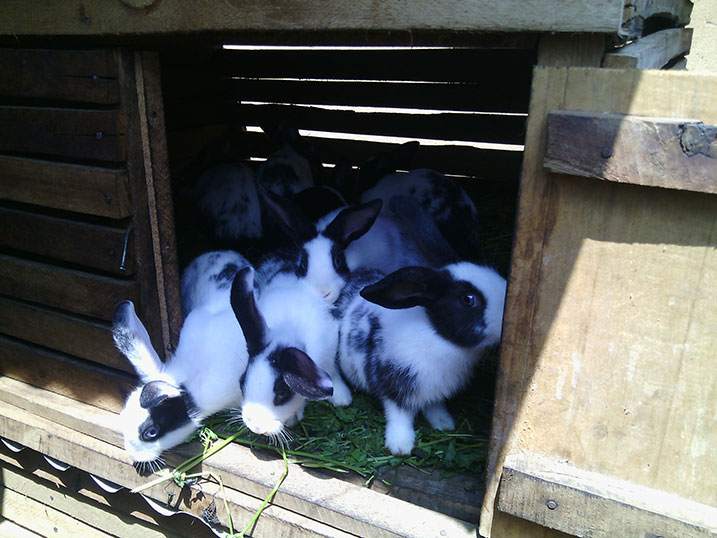
Rabbit breeding in Rwanda is being promoted as a simple, accessible solution for households struggling to afford meat, with experts saying almost anyone can do it.
Some authorities, including Senator Prof. Jean Pierre Dusingizemungu, are calling on institutions in charge to encourage citizens to raise rabbits, noting that they reproduce quickly and require far fewer resources than other livestock.
This push comes at a time when food prices—especially meat—continue to rise, while cases of malnutrition persist in different parts of the country.
A rabbit farmer from Gahanga Sector in Kicukiro District, together with the Ministry of Agriculture and Animal Resources (MINAGRI), agrees that many Rwandans have the potential to take up rabbit farming.
The farmer, referred to here as Nyirankunzineza, raises rabbits in a small, shelf-like structure at home—similar to what many households could manage. Despite supporting a family of 15 people, she says she has completely stopped buying meat.
She explains that building her rabbit shelter cost less than 60,000 Rwandan francs, and her main challenge is simply finding grass for feed. In the entire time she has been raising them, she has not needed any medication.
The rabbits feed on a variety of locally available plants, including wild greens, cabbage leaves (without chemicals), sweet potato vines—especially during the dry season—and other types of grass.
“I haven’t bought meat since I started raising rabbits more than two years ago,” she says. “Whenever we want meat, we just have it. With prices so high, I decided to start after realizing I couldn’t afford enough meat for my family of 15.”
She adds that rabbit farming is very easy to manage. “I keep between 30 and 40 rabbits. They don’t need medication when they are few, and they eat almost anything available nearby.”
According to her experience, a mature rabbit gives birth every month to between 8 and 11 young ones. After just four to five months, the offspring are already ready to reproduce, while some can be used for meat even earlier.
In March, during a Senate plenary session reviewing livestock development in Rwanda, Prof. Dusingizemungu emphasized that rabbit farming could help address malnutrition, especially among low-income households.
“Rabbit farming can provide real solutions, yet it is still overlooked,” he said. “It doesn’t require expensive feed, and rabbit meat is healthy, lean, and could significantly improve nutrition.”
He also stressed that rabbits multiply quickly, making them a practical way to tackle persistent dietary challenges if more effort is invested in promoting the practice.
Claire d’André Hirwa, Senior Researcher and Monogastric Program Coordinator at the Rwanda Agriculture and Animal Resources Development Board (RAB) under MINAGRI, noted that while over three million Rwandan households need more access to meat, the government has already set targets for rabbit production by 2029.
She explained that under the current five-year plan, rabbit numbers are expected to grow significantly—from over 654,000 counted in 2024 to more than 734,000 by 2029—thanks to their high reproduction rate of 8 to 12 offspring per rabbit.
Hirwa also encouraged more people to take up rabbit farming, highlighting that it is affordable and accessible, though many still lack knowledge about how to do it.
She added that rabbit meat is particularly nutritious, being low in fat and rich in protein and minerals, making it especially beneficial for people with weaker health conditions.