
 Simon Kamuzinzi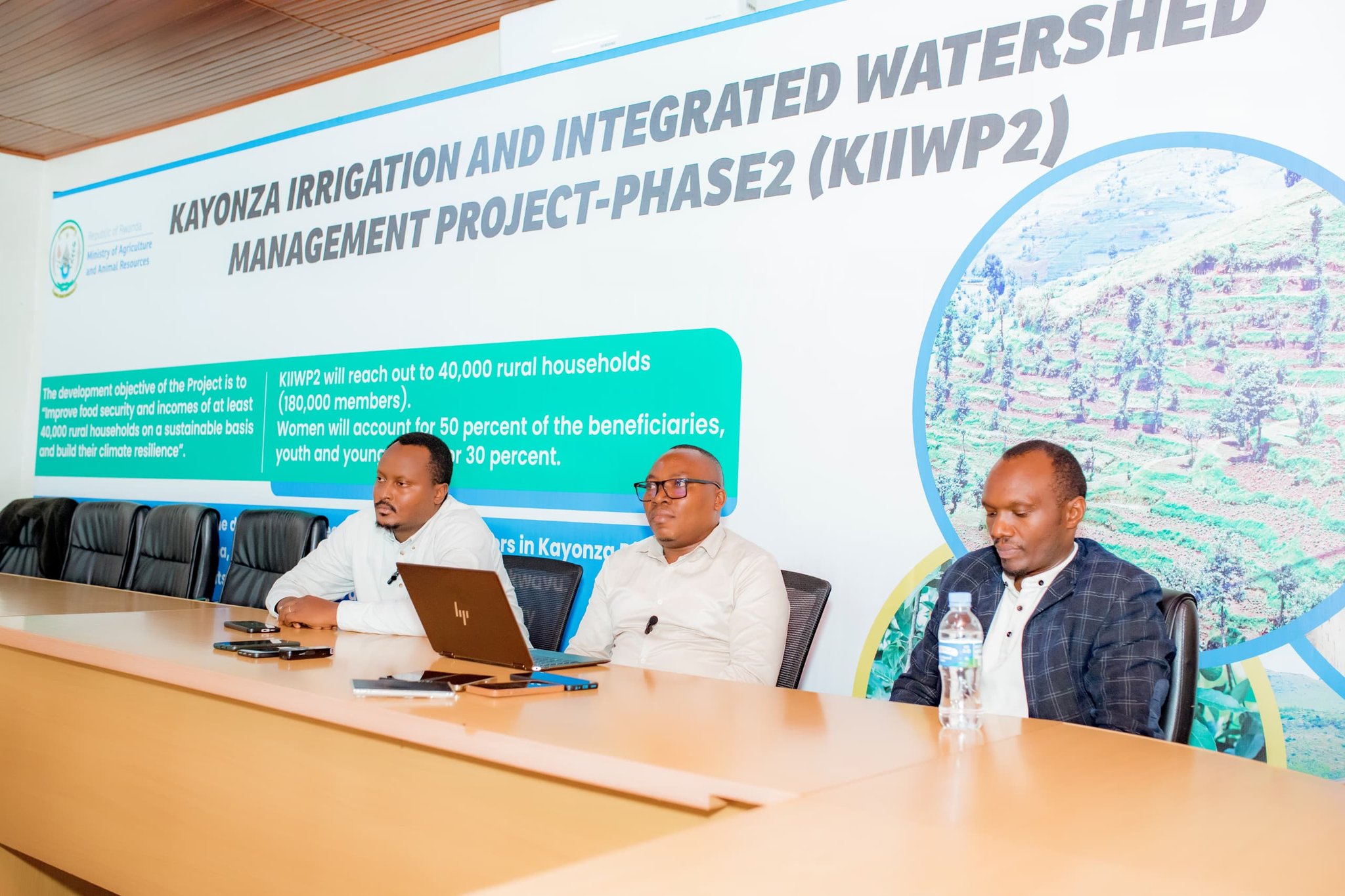
In eastern Rwanda’s Kayonza District, an area once synonymous with chronic drought is being repositioned as a prime destination for year-round agriculture and agribusiness investment.
The transformation is being driven by the government-backed Kayonza Irrigation and Integrated Watershed Management Project (KIIWP), which says investors now have the opportunity to farm throughout the year—no longer dependent on seasonal rains—thanks to newly developed water infrastructure and community resilience programs.
Launched in response to the devastating 2016–2017 drought, the project targets more than 180,000 residents from over 40,000 households across the sectors of Mwiri, Ndego, Kabare, Rwinkwavu and Murundi. Officials say the livelihoods of these communities could have deteriorated significantly had the government not intervened.
Since 2020, KIIWP has enabled farmers to irrigate crops and provide water for livestock through the construction of 15 dams and 20 boreholes. The project has also rehabilitated degraded land, building terraces across 1,300 hectares and planting agroforestry trees to curb soil erosion.
During its first phase (2020–2024), the project supported the planting of fruit trees—including avocado, orange, mango, lemon and jackfruit—across 1,337 hectares. The goal was to protect hillsides, improve nutrition and boost household incomes.
The second phase (2022–2028) significantly scales up these efforts. Plans include afforestation on 3,475 hectares and terracing on an additional 3,850 hectares, building on the earlier 1,300 hectares. Irrigation infrastructure will cover more than 5,085 hectares using water from Lakes Kibare, Nasho and Ihema in Ndego Sector.
Two new dams are also planned: a 12-meter-high structure to irrigate 150 hectares—including 40 hectares in Kanyeganyege marshland—and another five-meter dam to irrigate 125 hectares in Gishanda. In areas with available water but outside the main irrigation command area, farmers will receive subsidized irrigation equipment through matching grants.
Beyond irrigation, the project is investing in value addition and agribusiness development. At least 50 greenhouses will be built for youth groups, creating over 400 jobs focused on market-oriented crops such as chili. To reduce post-harvest losses and ensure year-round food supply, 55 drying shelters and storage facilities will be constructed, alongside four mechanical dryers and three small agro-processing plants.
Cold storage facilities will also be established to preserve fruits and vegetables before they reach markets. Farmers, cooperatives and entrepreneurs will access matching grants to support these investments.
According to Jean de Dieu Rudacogora, KIIWP’s Investment and Financial Inclusion Specialist, the project prioritizes crops that address malnutrition and meet strong market demand, including maize, rice, beans, soybeans, potatoes, sweet potatoes, cassava, vegetables and fruits.
Financing will be channeled through financial institutions, with local SACCOs already being trained to offer agriculture-friendly loans for irrigation infrastructure and post-harvest facilities.
Women investors in farming and livestock will be eligible for grants covering 50 percent of their capital, while youth—including young parents—can receive up to 70 percent support. Youth-led tech-driven projects may also qualify for loans without collateral.
“Water is available all year and does not dry up,” Rudacogora said. “We want private investors and cooperatives to seize this opportunity. What is required is a clear partnership agreement with farmers in Kayonza.”
Mandela Dan, who oversees value chain development, says water security eliminates the main risk typically associated with agriculture in the region. The only remaining gap—irrigation works in parts of Ndego—is already under procurement.
The project, financed with more than $205 million from the International Fund for Agricultural Development (IFAD) and other partners, is implemented by the Rwanda Agriculture and Animal Resources Development Board (RAB).
For Kayonza, once battered by drought, the narrative is shifting—from survival to sustained agricultural growth.