
 Simon Kamuzinzi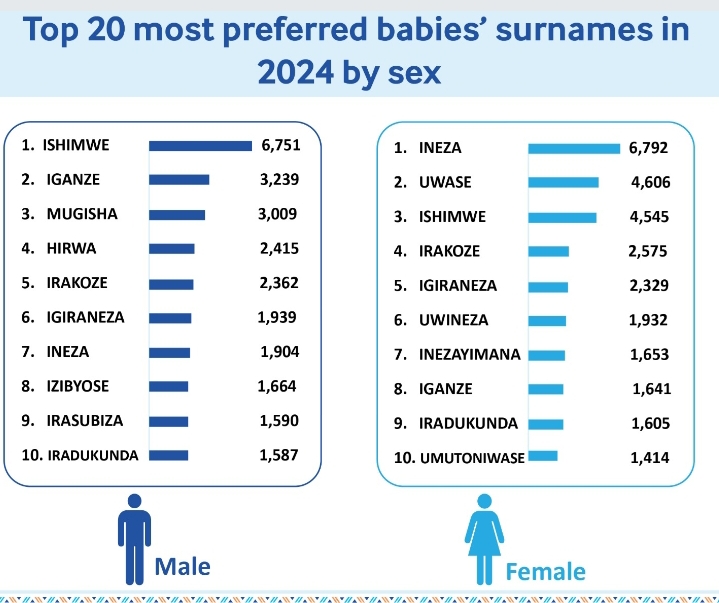
Beyond Rwanda’s registered 341,029 live births in 2024, trending names among the newborns, Ishimwе” emerged as the most given baby surname nationwide, according to the Rwanda Vital Statistics Report 2024 released by the National Institute of Statistics of Rwanda (NISR).
Rwanda is still reflecting a sustained high birth rate and a youthful population, even though fertility rate per woman goes declining from 6.1 in 2005 to 3.7 in 2025,
as cited in the Rwanda Demographic and Health Survey (DHS7) which was published earlier this week.
Civil registration data of 2024 show that 6,751 male babies and 4,545 female babies were named Ishimwе in 2024, bringing the total to 11,296 newborns, more than any other surname recorded during the year.
Among male babies, Ishimwе ranked first, followed by Iganze (3,239), Mugisha (3,009), Hirwa (2,415) and Irakoze (2,362). Other frequently given male surnames included Igiraneza, Ineza, Izibyose, Irasubiza and Iradukunda.
For female babies, Ineza topped the list with 6,792 registrations, followed by Uwase (4,606) and Ishimwе (4,545). The top ten female surnames also included Irakoze, Igiraneza, Uwineza, Inezayimana, Iganze, Iradukunda and Umutoniwase.
The popularity of these surnames reflects Rwanda’s long-standing cultural practice of giving children names that convey gratitude, moral values, blessings and positive aspirations.
Many of the most common names are associated with meanings linked to goodness, grace, faith and thankfulness.
Rwandan Journalist, Ishimwe Israel, says that welcoming a newborn child is often accompanied by the words “Thanks to God(Imana ishimwe),” and the name naturally sticks to the child.
“This is linked to a period of gratitude my parents were going through. Receiving a child is like receiving a blessing. A parent says to themselves, ‘I have found someone who will support me in my old age,’” Ishimwe explains.
The report also shows that more boys than girls were born in 2024, with 172,460 male births compared to 168,569 female births, resulting in a sex ratio at birth of 102.3 males per 100 females.
NISR notes that birth registration completeness reached 90.3% in 2024, indicating continued improvements in the civil registration system and the reliability of birth statistics.